No lift without a decay path
Every prototype is designed to fail back to passive support. A run is not considered successful unless the shutdown trace is as clean as the lift trace.
About us
Elythen Labs is a Long Beach deep-tech company turning lift-field research into an OEM-ready module platform for industrial teams that need controlled, bounded payload motion before their products reach production. The company is small, hardware-heavy, and most comfortable in the gap between a physics result and a product safety review.
The company started as a small research bench inside a leased industrial bay, where the founders were trying to keep a 40 kg sealed test article stable without a crane, gantry, or mechanical suspension point. The first useful breakthrough was not height. It was repeatable behavior under closed-loop sensing.
That pushed Elythen away from selling spectacle and toward supplying the hard middle layer: sealed LFM modules, drive electronics, simulation, runtime controls, telemetry, and field engineering for partners building their own end-user machines.
The headquarters still feels more like a scrappy qualification shop than a campus: borrowed thermal chambers, marked-up floor tape, two machine tools that never cool down, and a meeting table covered with payload drawings from customers that cannot be named yet.
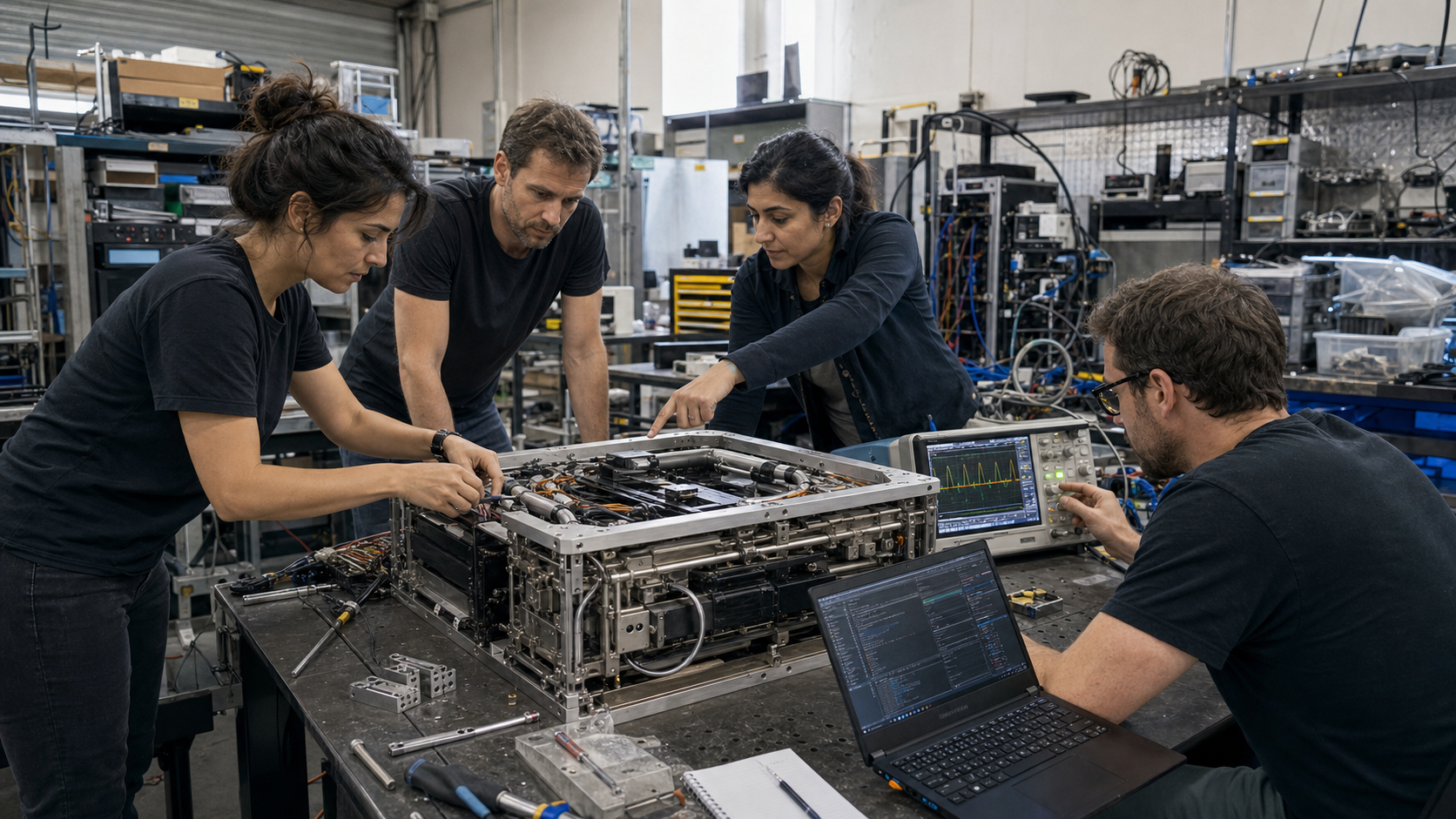
Elythen's internal culture is built around the difference between a compelling phenomenon and a shippable subsystem. The founders talk about lift as an effect to be bounded, measured, and de-risked, not a miracle to be celebrated on a stage.
That restraint is part of the operating culture: a company commercializing a deeply unfamiliar technology by behaving like a supplier of industrial brakes, drives, and safety controllers.
Every prototype is designed to fail back to passive support. A run is not considered successful unless the shutdown trace is as clean as the lift trace.
Customer-facing claims are tied to run IDs, calibrated fixtures, and environmental logs. If an effect only appears when the room is quiet and the team is excited, it does not leave the lab.
Cable routing, coolant flow, floor anchors, exclusion zones, spare modules, and service access are discussed before anyone argues about maximum lift.
Long Beach, California; leased industrial bay with machine shop, metrology room, and two fenced pilot cells
Paid design-partner programs with controlled pilot cells in validation
Research, controls software, field engineering, safety documentation, and partner operations
Development kits first, then production allocations after payload-envelope evidence review
Elythen's team combines hard-science research, safety-critical software, and industrial deployment experience so customers can evaluate lift-field capability as an engineered subsystem rather than a lab phenomenon.

Flight dynamics researcher turned industrial systems operator. Mira led autonomous docking programs for orbital servicing hardware, then brought that verification discipline to factories where short heavy moves cause long delays.

Applied physicist focused on field-stabilized materials, low-temperature devices, and metrology. Theo built Elythen's first closed-loop lift cell and owns the core safety envelope math.

Former warehouse automation product leader who has shipped conveyors, AMR integrations, and support programs into conservative facilities. Sahana turns lab capability into something OEMs can qualify, purchase, and support.

Safety-critical software builder from aviation and surgical robotics. Jonas leads Anchor Runtime, signed telemetry, fault injection, and the qualification toolchain partners use in their own reviews.
No. Elythen Labs is an invented company profile. The anti-gravity technology, team, product specs, pilot programs, and site content are constructed so the site can feel like a credible customer website without representing a real customer or real product claims.
Pilot access
Elythen works with OEM engineering teams on bounded pilot cells, module integration, safety evidence, and pre-production validation.